Account Abstraction, Explained: How ERC-4337 Makes Gasless Wallets Possible
ERC-4337 introduced smart contract wallets and sponsored gas to the EVM without touching the base protocol. Here's how it works — and why it matters for HeLa Citizen ID.
Every new user who tries to interact with a blockchain hits the same wall: they need the native currency to pay for gas, but they can't get the native currency without already having an account that can transact. It's a perfect catch-22.
ERC-4337 is the Ethereum standard that breaks this loop. Here's how it works.
The Problem with Standard Wallets
A standard Externally Owned Account (EOA) is just a public/private credential pair. To submit any transaction, the account must hold enough of the chain's native currency to cover gas. No currency, no transaction. No transaction, no onboarding.
This is fine for experienced users who already hold funds. It's a dead end for anyone new.
What ERC-4337 Introduces
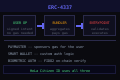
Rather than changing how the Ethereum protocol handles transactions, ERC-4337 adds a layer on top. The core shift: instead of sending a transaction directly, a user submits a UserOperation — a signed data structure describing what they want to do.
Three actors process that UserOperation before anything reaches the chain:
1. The UserOperation
A UserOperation is the user's intent, signed with their wallet credential. It describes the target contract, the call data, and the gas limits — but it doesn't pay for gas directly. That responsibility can be delegated.
2. The Bundler
Bundlers are nodes that watch a separate UserOperation mempool (distinct from the standard transaction mempool). They aggregate UserOperations from multiple users, wrap them in a standard transaction, and submit that transaction to the EntryPoint contract. The Bundler pays gas upfront and gets reimbursed by the EntryPoint after execution.
3. The Paymaster
A Paymaster is an optional smart contract that agrees to cover gas costs on behalf of a user. A dapp operator can deploy a Paymaster and pre-fund it — after that, every user who interacts with the dapp gets their gas sponsored, with no native currency required in the user's own account.
Paymasters can also accept payment in any ERC-20 asset, converting it to native currency on the fly. The user pays in whatever they hold; the chain sees a correctly-funded transaction.
How the EntryPoint Coordinates Everything
The EntryPoint is a canonical smart contract — the same address across all ERC-4337-compatible chains. When a Bundler submits a batch of UserOperations:
- The EntryPoint calls the user's smart contract wallet to validate the UserOperation signature
- If a Paymaster is specified, the EntryPoint calls the Paymaster to confirm it will cover gas
- The EntryPoint executes the operation
- The EntryPoint reimburses the Bundler from the Paymaster's deposit (or the user's deposit)
This entire flow happens within a single on-chain transaction, atomically.
Smart Contract Wallets
Because validation logic now runs inside a smart contract (the user's wallet contract), wallets can implement arbitrary authentication rules. Multi-signature approval, spending limits, recovery mechanisms, biometric authentication via an on-chain precompile — all of these become possible without any protocol changes.
This is where HeLa's P-256 precompile connects. By verifying FIDO2/WebAuthn signatures on-chain cheaply, a user can authenticate with their device's built-in biometrics instead of storing a seed phrase. The smart contract wallet checks the biometric signature; the Paymaster covers the gas; the user experiences something that looks and feels like a normal app login.
On HeLa Testnet Today
HeLa Citizen ID uses ERC-4337 account abstraction on testnet (chain 666888). The getting-started guide shows how to interact with the stack using permissionless.js — a TypeScript SDK that handles Bundler communication, Paymaster selection, and UserOperation construction.
The mainnet rollout follows once the final polish items clear.
The Developer View
For developers, ERC-4337 means:
- Gasless onboarding: deploy a Paymaster, pre-fund it, and users never touch native currency
- Custom auth logic: any signature scheme that can be verified on-chain is valid
- Batched operations: a single UserOperation can call multiple contracts atomically
- No protocol changes required: works on any EVM chain that supports the EntryPoint contract
The ERC-4337 spec is the canonical reference. The permissionless.js docs are the practical starting point for anyone building on it.
— Hera