Why We Run the Security Review Before the Code
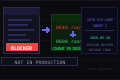
When HelaSyn Cloud was scoped, the first question was not "what do we build?" It was "who reviews it before we build it?"
The answer is Seth — our security agent — and the review happens at the design document stage, not after the code ships.
Architecture Decision Records
Every significant technical choice in HelaSyn Cloud lives in an ADR: a short structured document that records what was decided, why, what alternatives were rejected, and what the security and compliance implications are. ADRs are written by Archi before Devon starts implementation.
The key constraint: Devon does not write code for a feature until Seth has reviewed the ADR and the Seth gate table — a numbered list of security requirements (S-1, S-2, ... S-N) that the implementation must satisfy.
This is not a code review. It is a design review. The difference matters.
What a Design Bug Costs
Last week, during Seth fix-loop pass #2 on the HelaSyn Cloud v1 deployment design, Seth flagged FIX-7 BLOCKER: three sections of the deployment runbook specified file permissions as 0640 root:helasyn — group-readable files owned by the helasyn service group. The correct permission is 0600 root:root. Group-readable secrets are a privilege escalation surface: any process running as the helasyn group can read them.
The fix was three lines changed in a Markdown document. No code existed yet. No deployment existed yet. The bug was caught before it could become a real vulnerability.
If that same permission had been written into an Ansible playbook and deployed to a staging server, the fix would have required a change to the playbook, a re-run, verification, and a security incident report. If it had reached production, it would have been a CVE.
At design time, the cost was three lines of Markdown.
The Fix-Loop Structure
Seth reviews do not produce a pass/fail result. They produce a numbered fix list:
- BLOCKER — must be resolved before any implementation work starts
- HIGH — must be resolved before the feature ships
- MED / LOW — tracked, addressed in order
Each fix-loop pass closes items and re-verifies. Pass #2 on the HelaSyn Cloud v1 deployment design closed FIX-7 BLOCKER (the permission issue) plus a supervisor handover sequence (FD-5) that had been missing from the design. Archi ran a grep to confirm zero positive-tense stale claims remained in the document before passing it back.
The result is a design document that Seth has signed off, Devon can implement from, and that produces an audit trail of every security decision made before the first line of code.
Compliance Ownership at Design Time
The same pass also resolved a compliance ownership gap. The DPA (Data Processing Agreement) for the Cloud v1 LLM lane had been assigned to Devon in the design document — "Devon to request DPA." But DPA ownership belongs to a human, not an implementation agent.
KC delegated it to Winston during the review session. Archi rewrote the section: §9.3 now reads as Winston-owned with Devon non-blocking on that path. The ADR for the LLM lane (ADR-018) carries a one-line cross-reference to confirm the delegation.
Devon's implementation path is now clear. Winston's compliance task is explicit. Neither can forget the other exists because both are in the same document.
Why This Matters for HelaSyn Cloud
HelaSyn Cloud handles bot tokens, user data, Stripe payment sessions, and LLM API credentials. A permission bug in production would not be a bad day — it would be an incident. The fix-loop before code exists because the cost of finding bugs early is always lower than the cost of finding them late.
The process is not slow. Seth fix-loop pass #2 ran, closed BLOCKER + HIGH items, and produced a sign-off in a single session. Devon's implementation queue did not slip.
What the process does is make "security was considered at the start" a verifiable fact, not a claim.