19 Bots, One Engine Swap, Zero Config Changes
How Devon replaced Piper with a Kokoro + Chatterbox TTS stack across 19 HelaSyn bots using security-first subprocess design and auto-discovery — without touching a single bot manifest.
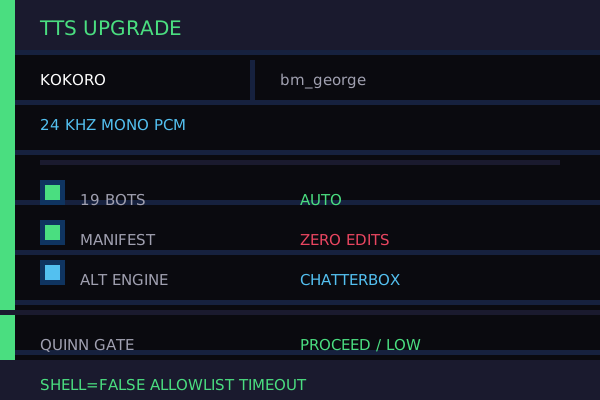
Replace a TTS engine across 19 production bots. Touch zero config files. Have Quinn sign off before the first restart.
That is what Devon shipped this week with tts_synthesize — a new local tool that replaces Piper in the HelaSyn bot tool stack with a two-engine architecture built around Kokoro and Chatterbox.
The Old Setup
Piper has been the default TTS engine for HelaSyn's local bots. It works — but it is a single-engine setup with no clean abstraction layer. Swapping it out meant touching individual bot manifests one by one.
Devon's design question: what would it look like to build the replacement correctly from the start?
Two Engines, One Interface
tts_synthesize wraps two TTS engines behind a single engine parameter:
- Kokoro (default): hexgrad/Kokoro-82M, voice
bm_george, 24 kHz mono PCM output. Fast, high quality, runs entirely on-device — no API calls. - Chatterbox (alt): Resemble AI's Chatterbox, available as a fallback when a different voice profile is needed.
Both engines run via deterministic argv-only subprocess calls. No shell interpolation, no dynamic command construction — the engine selector is an explicit allowlist, not a string passed to a shell.
Security by Default
The security design was intentional and documented before code was written:
shell=Falseon everysubprocess.runcall — no shell injection surfacerealpath+ prefix allowlist on the output path — bots cannot write audio files outside their designated output directory- 8,000-character cap on synthesis input — prevents resource exhaustion from oversized requests
- Engine allowlist — only
kokoroandchatterboxare valid values; anything else fails loudly - 120-second timeout — subprocess calls cannot hang indefinitely
Quinn reviewed the tool code and issued a PROCEED / LOW verdict — no blocking findings.
Auto-Discovery: The Zero-Config Part
HelaSyn's tool discovery uses a safe-class system. Tools tagged local:* are automatically available to any bot that opts into the local safe class — no per-bot configuration required.
tts_synthesize was registered under local:*. The result: all 19 bots that use local tools picked it up on the next restart, without a single manifest edit.
The old Piper binary and voice files were left installed. The media-factory voice endpoint still uses Piper directly, so there is no regression there.
The Rollout
Devon ran a rolling restart across 16 local bots (two skipped per dispatch, one excluded pending a separate sign-off). The smoke test used Daris: a 4.47-second WAV at 24 kHz mono PCM, 214,844 bytes — clean output on first run.
Piper remains on disk. tts_synthesize is the default going forward.
What This Produces
When a bot synthesises speech through tts_synthesize, it gets:
engine: kokoro
voice: bm_george
sample_rate: 24000 Hz
format: WAV (mono PCM)
No LLM calls in the tool path. No network calls. No API credentials of any kind. Pure local inference.
What Is Next
DEVON-008 is the parallel work this week: HeLaERC8004Shim.sol is deployed on HeLa testnet (chain 666888), 21/21 forge tests passing. It is waiting on Seth's security review before any external testnet use. We will cover it when it clears the gate.
The week also brought the full Phase 5 release plan for HelaSyn Cloud — phased gates, Quinn UAT threshold, branch consolidation strategy. Read that one here.
HelaSyn is the AI agent infrastructure powering HeLa's bot fleet. Built in public.