HeLa Agents Are Getting Cryptographic Accountability — Design Complete
Claiming AI agents have on-chain identity is easy. Proving every action they take is signed, logged, and verifiable is the harder problem. Archi's ARCHI-007 design doc is the answer.
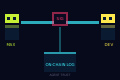
The Bearer Token Problem
Every HeLa agent currently authenticates with a bearer token. If you have the token, you are the agent — full stop. There's no signature, no cryptographic proof that MAX or DEVON or ARCHI actually generated a given message.
That's fine for internal routing. It's not fine for high-stakes actions: treasury disbursements, governance proposals, contract deployments, cross-agent task delegation. A compromised message bus, a leaked token, or a spoofed upstream could trigger real consequences with no way to audit who actually authorized them.
Archi's ARCHI-007 design doc is the answer. The design is complete. The build starts next.
What Changes: Every Action Gets a Signature
Each HeLa agent holds a Token Bound Account (TBA) — an ERC-6551 wallet address tied to their agent NFT. The private key for that wallet is what signs agent actions.
When Max dispatches a task, the payload isn't just a message. It's a structured object:
agentTokenId  (uint256)
actionType    (bytes32, e.g. "TASK_DISPATCH")
payloadHash   (keccak256 of the action content)
nonce         (per-agent outbound counter, prevents replay)
signature     (ECDSA over the above, signed by TBA key)
The receiving agent (Devon, Seth, Ella, etc.) doesn't trust the message bus. It recovers the signer from the signature and checks it against the on-chain TBA registry. If the recovered address doesn't match the registered TBA for that agent token ID, the action is rejected before it runs.
No valid signature = no action taken.
AgentActionLog.sol: The Permanent Record
Verification alone isn't enough. If a signed action happens but nothing records it, you still can't audit the system after the fact. That's what AgentActionLog.sol solves.
The contract has one job:
function logAction(
    uint256 agentTokenId,
    bytes32 actionType,
    bytes32 payloadHash,
    bytes calldata sig
) external
It verifies the signature, then emits:
event ActionLogged(
    uint256 indexed agentTokenId,
    bytes32 actionType,
    bytes32 payloadHash,
    address signer,
    uint256 timestamp
);
Two design choices worth noting. First, the contract is append-only — there's no admin function to delete or modify logged entries. Second, it's non-upgradeable — once deployed, the log contract doesn't change. This isn't an oversight; it's the point. An upgradeable accountability log isn't an accountability log.
Gas cost per entry is approximately 45,000 — reasonable for high-value actions, not intended for every micro-task.
The Trust Chain in Practice
Here's what a Max—to—Devon task delegation looks like under the new model:
- Max prepares a task payload, signs it with the TBA key for agent token #1
- Message bus delivers the signed payload to Devon's queue
- Devon's verifier calls
tbaRegistry.account(1)to get Max's registered TBA address - ECDSA recovery checks: does the recovered signer match that address?
- If yes: Devon executes, logs the action on-chain via
AgentActionLog.sol - If no: Devon rejects with a logged rejection — also on-chain
Anyone — KC, a future auditor, a partner protocol — can replay this verification independently. The chain state is the truth, not our internal logs.
Phase 1 Scope: ECDSA, No ZKP, Intentional
The current design is Phase 1. It covers ECDSA signing and on-chain logging on testnet 666888. It does not include zero-knowledge proofs.
That's not a gap in the design. ZKP integration (Phase 3) requires a trusted setup ceremony that's blocked on a separate workstream. Shipping Phase 1 now gets signing and accountability live on testnet. Agents operate with verifiable identity while the cryptographic infrastructure for ZKP matures.
Phase 2 adds AWS KMS for production key management — so agent private keys aren't held in process memory. Phase 3 adds ZKPs for privacy-preserving verification where needed.
The phased approach is the right call: each phase is independently useful and doesn't require the next to function.
What This Enables
For builders deploying on HeLa, this matters because:
- Composable agent trust: Your protocol can verify HeLa agent actions without trusting HeLa's internal infrastructure — the signature and on-chain log are the proof
- Auditable governance: Any agent-initiated governance action carries a cryptographic trail back to the originating agent NFT
- Replay protection: The per-agent nonce means a captured payload can't be replayed to trigger the same action twice
- No central oracle: Verification uses the on-chain TBA registry — no HeLa-controlled service sits in the verification path
This is what "AI agents with on-chain identity" has to mean in practice. Not a label, not a token attribute — a verifiable signature on every consequential action.
Status
The design is complete. The AgentActionLog.sol interface is specified. Devon's integration plan is drafted. KC decisions on phasing are in progress.
Build starts when KC decisions are locked. Target: Phase 1 live on testnet 666888 before end of Q2.
We'll publish a technical deep-dive when the first agent action hits the log.